Know what changed.Know what was true.
ChronoInsights adds a durable, queryable history to the endpoint tools you already use—so security and IT operations teams can investigate what was installed, vulnerable, or changing at the moment that mattered.
Answer the endpoint questions your existing tools leave open.
ChronoInsights complements EDR, RMM, vulnerability, and inventory tools when the answer depends on what was true before—not only what is visible now.
“What changed in the hours before the failure?”
“Which endpoints were exposed, and when did that stop being true?”
“Can we show the evidence—not only today’s state?”
Follow an issue from signal to historical evidence.
Prioritize current risk, inspect the affected endpoints, and return to the recorded evidence when the investigation changes.
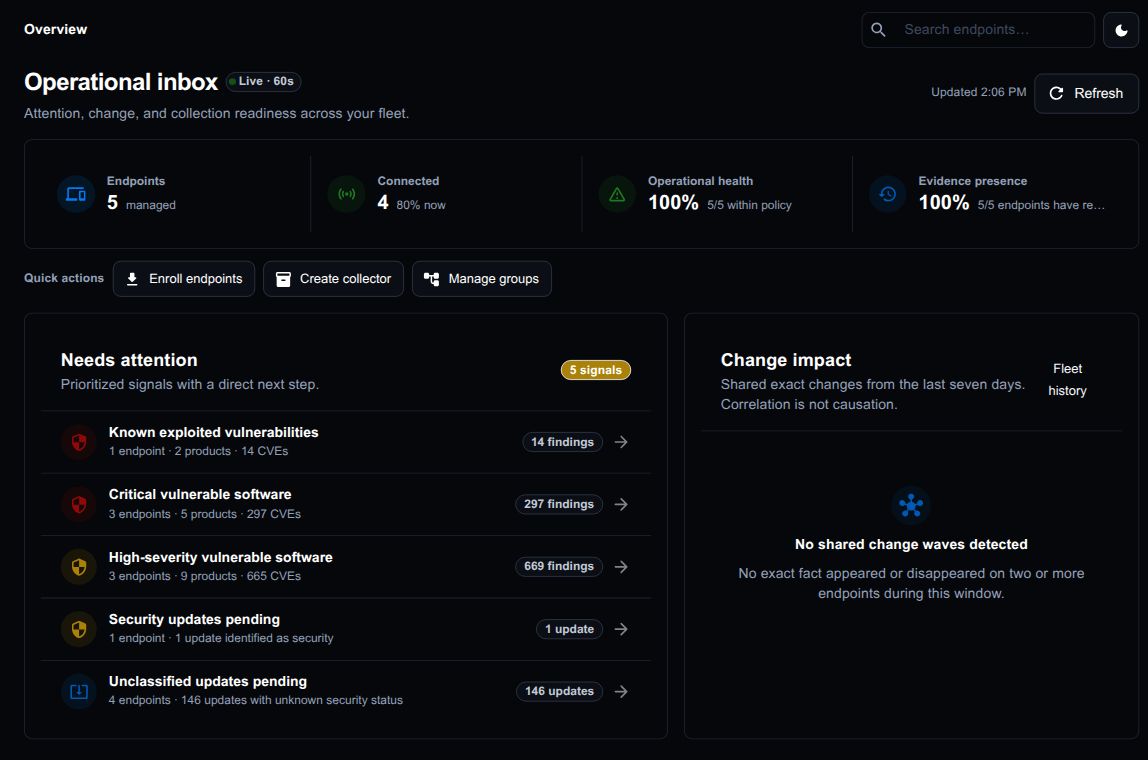
Start with the risks that deserve attention
Turn fleet telemetry into a prioritized operational inbox. See known-exploited vulnerabilities, critical software risk, update posture, evidence coverage, and shared change patterns without digging through separate reports.
Move from “what is noisy?” to “what should we do next?”
Explore the product with representative endpoint evidence.
Move through fleet risk, natural-language investigation, historical state, and custom collection—without installing an agent.
Explore product tourDesign the endpoint evidence your environment actually needs.
The visual collector designer is not the product's final destination—it is how administrators close evidence gaps without waiting for a hard-coded backend feature. The facts it produces remain available to filters, history, and natural-language investigation.
Chain small, reusable collection functions
Target Windows, macOS, and Linux capabilities
Publish custom facts into the same temporal model
Start with the endpoint questions that already hurt.
Choose a high-value question, collect the facts it requires, and evaluate whether the evidence supports a trustworthy answer.
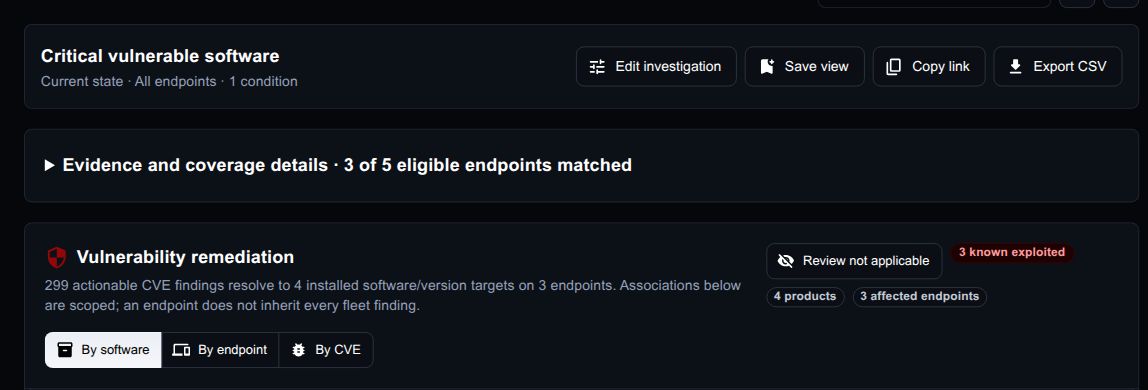
Vulnerability prioritization
Connect software identity and version evidence to CVEs, known exploitation, confidence, affected endpoints, and an actionable remediation view.
Incident reconstruction
Ask which processes, software, sessions, crashes, or custom facts were present before and during an event—not merely what remains afterward.
Change and drift analysis
Find facts that appeared, disappeared, or changed across an endpoint cohort, and compare current state with a recorded point in time.
Audit and operational evidence
Retain inspectable evidence for patch posture, software presence, local configuration, and organization-specific controls collected over time.
Bring one endpoint question and a representative endpoint group.
We will measure collection coverage, runtime, and answer quality before asking you to broaden the deployment.
What teams usually ask first
ChronoInsights is an endpoint evidence and investigation platform. It is designed to complement endpoint management, EDR, vulnerability, and service-management tools by preserving queryable state over time and making cross-fact investigations easier. The right integration or replacement boundary depends on the workflows and evidence you already have.
Built-in collectors cover useful endpoint evidence such as software, operating-system and update posture, accounts, sessions, and application crash events. Administrators can also define custom facts with reusable collection functions, while keeping identity and installation evidence decoupled where that distinction matters.
ChronoInsights records when facts are observed as valid and when they stop being valid. A point-in-time view reconstructs the best-known retained evidence for that moment rather than copying today’s inventory backward. Coverage and freshness limitations remain visible because missing evidence is not proof of absence.
No. Ask Your Environment is read-only. It maps a question to the tenant’s fact catalog, validates a typed investigation plan, and returns evidence. Administrators can inspect the generated GraphQL and variables rather than trusting an opaque answer.
That is a core design goal. Custom collector facts participate in the same endpoint-has-fact grammar and can be exposed to filters, temporal investigations, and natural-language planning through their declared evidence contracts instead of product-specific hard coding.